Middle School
Grades 7 - 8
Small class sizes. Big thinking. A nurturing environment where each child is truly seen.
Learn your way
Our 7th and 8th Grade program began in 2017 and has become one of the best on the island. Your child learns through the robust CCSLC curriculum with world-learning fusion in our Grade 7 and 8 classrooms.
Why Choose Omololu for Grade 7 and 8?
The tween years, those in-between moments from childhood to adolescence, are often underestimated, tucked between the tenderness of early childhood and the turmoil of teenagehood. But this stretch is where identity begins to take form, where self-worth is quietly sculpted, and where the stories kids start to believe about themselves take root.
Giving tweens a solid foundation in education isn’t just about teaching them to write a paragraph or solve an equation. It’s about offering them a safe space to explore who they are and how they relate to the world. It’s about teaching them that questions matter more than quick answers, that their voice has weight, and that mistakes are part of becoming.

What the CCSLC?
The CCSLC, developed by the Caribbean Examinations Council (CXC), is designed to ensure that students across the Caribbean are equipped with the competencies necessary for employment, further education, and everyday life. The curriculum is competency-based and emphasizes practical skills, communication, problem-solving, and teamwork. It is introduced in Grade 7 and leads up to examinations in core subjects such as English, Mathematics, Integrated Science, Social Studies, and Modern Languages. Students at Omololu International School take their CCSLC exit exams at the end of Grade 8.

Blending CCSLC and World Learning for Holistic Growth
At the heart of any strong educational model lies the commitment to developing well-rounded students equipped for success in an ever-evolving world. The Omololu International School middle school programme that thoughtfully merges the Caribbean Certificate of Secondary Level Competence (CCSLC) with the framework of the Montessori philosophy to offer students the best of both academic traditions. Students at Omololu blend rigour grounded in regional relevance and a global mindset that encourages inquiry, reflection, and personal growth.


Teaching and Learning Philosophy
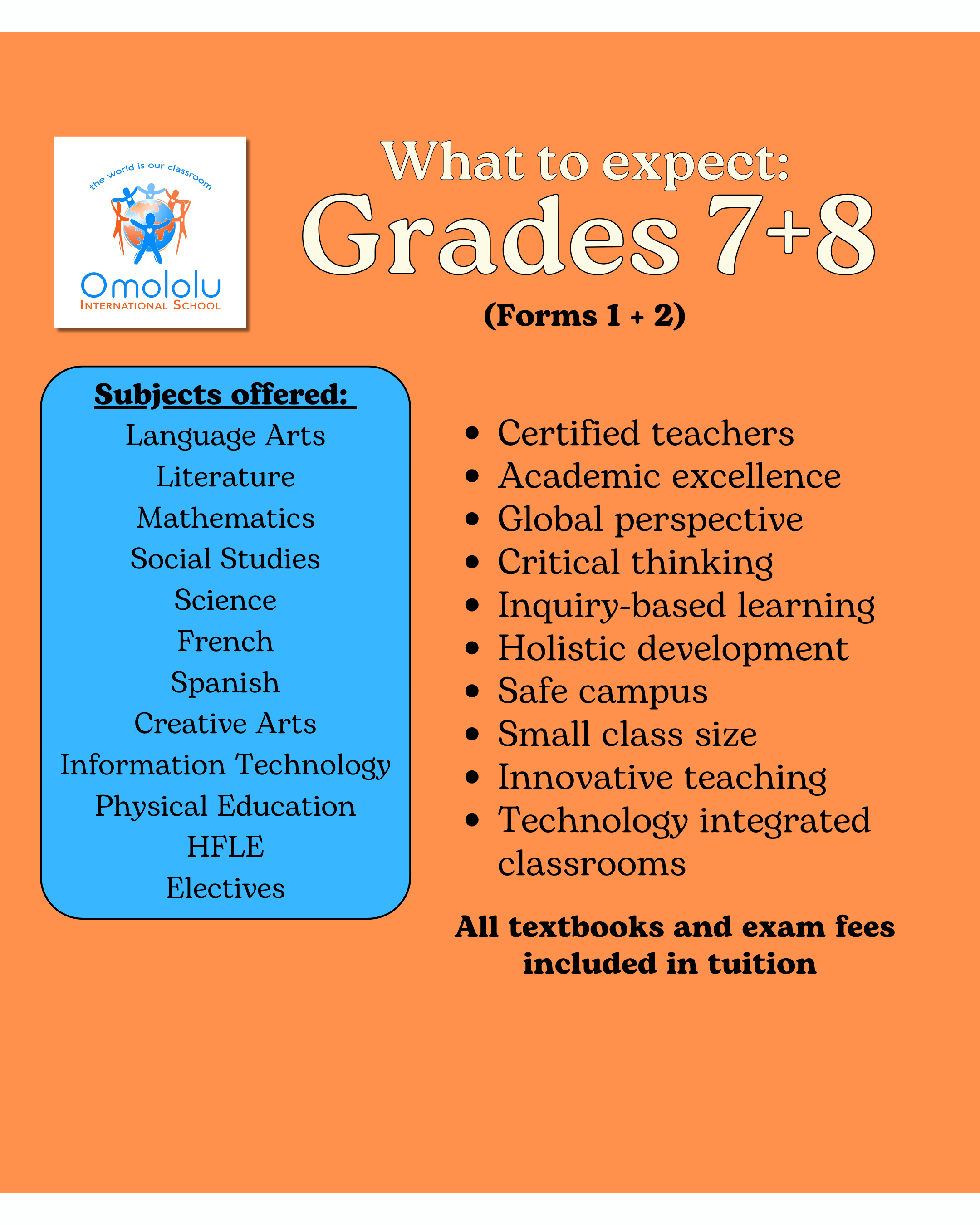
At Omololu International School, our approach to teaching is centered on developing students into lifelong learners who are curious, reflective, critical thinkers, and globally minded citizens. We believe meaningful learning goes beyond the delivery of content. Students are encouraged to ask questions, explore ideas deeply, make connections, reflect on their understanding, and apply their knowledge in authentic and purposeful ways.
Our classrooms foster inquiry, critical thinking, collaboration, creativity, and student agency, helping students develop not only strong academic foundations but also the skills, perspectives, and confidence they need to engage thoughtfully with the world around them.
Benefits of the Holistic Blended Model
This blended approach offers a number of distinct advantages to secondary students at Omololu International School:
Greater student engagement: students learn through hands-on, inquiry-driven activities that are rooted in familiar contexts.
Dual skill development: students grow both academically and personally, meeting benchmarks for external exams while also developing 21st-century skills like self-management and collaboration.
Flexible assessment: students benefit from formative and summative assessments aligned to both frameworks, helping them track growth in meaningful ways.
Preparation for the future: students are ready for a range of academic pathways, whether they continue with CSEC, IGCSE, or transition into an IB Diploma Programme.
Ultimately, the middle school programme at Omololu International School produces learners who are competent, confident, and culturally grounded with the skills to thrive in both the Anguillian community and the wider world.